

Formulation Guide for Cosmetic Chemists & Skincare Brands | Sourcing Tips Included
Why Grape seed extract for cosmetics
Grape seed extract, derived from Vitis vinifera seeds, has become a cornerstone ingredient in modern cosmetic formulations. Valued for its compatibility with water-based and emulsion systems, stability across a wide pH range, and natural origin, it aligns perfectly with clean-label positioning that today’s beauty consumers demand .
For cosmetic formulators, the real value lies in its multifunctional roles within formulations:
- Antioxidant support – helps protect sensitive cosmetic systems from oxidative degradation
- Plant-based active support – works alongside other botanical extracts
- Stability contributor – supports shelf-life and formulation consistency when properly standardized
Unlike food-grade extracts, Grape seed extract for cosmetics prioritizes sensory properties—light color, neutral odor, and solubility—making it suitable for transparent serums, creams, and lotions .
Key Benefits for Skincare Formulations
1. Potent Antioxidant Protection
Grape seed extract for cosmetics. Usage rates, sourcing tips, and quality parameters. is exceptionally rich in polyphenols, particularly proanthocyanidins. Studies demonstrate its remarkable free radical scavenging capacity, with a DPPH IC50 value of 0.079 mg/mL . Total phenolic content can reach 430 mg gallic acid equivalent per gram of extract .
2. Anti-Aging & Enzyme Inhibition
Research confirms that Grape seed extract for cosmetics effectively inhibits key enzymes involved in skin aging:
- Elastase inhibition (IC50: 6.34 mg/L) – preserves skin elasticity by preventing elastin breakdown
- Tyrosinase inhibition (IC50: 168.82 mg/L) – helps address hyperpigmentation by reducing melanin production
In vivo studies demonstrate that GSE suppresses c-Jun N-terminal kinase (JNK) and NF-κB pathways while enhancing GSH-Px levels, significantly improving wrinkles and skin redness .
3. Antimicrobial Activity
Grape seed extract for cosmetics exhibits selective antibacterial activity against Staphylococcus aureus, including MRSA strains—making it a valuable addition to acne-fighting and preservative-boosting formulations .
4. UV Protection & Photoaging Defense
GSE protects skin from UV-induced inflammation by modulating MAPK and AMPK pathways . It mitigates DNA damage, apoptosis, and immune responses triggered by UV radiation .
5. Sustainability & Upcycling
Approximately 80% of global grape production goes to winemaking, generating 14.5 million tons of organic waste annually in Europe alone . By using grape seed extract, brands can incorporate upcycled ingredients into their products—a compelling sustainability story for eco-conscious consumers .
Cosmetic Product Categories Using Grape Seed Extract
Skincare Products
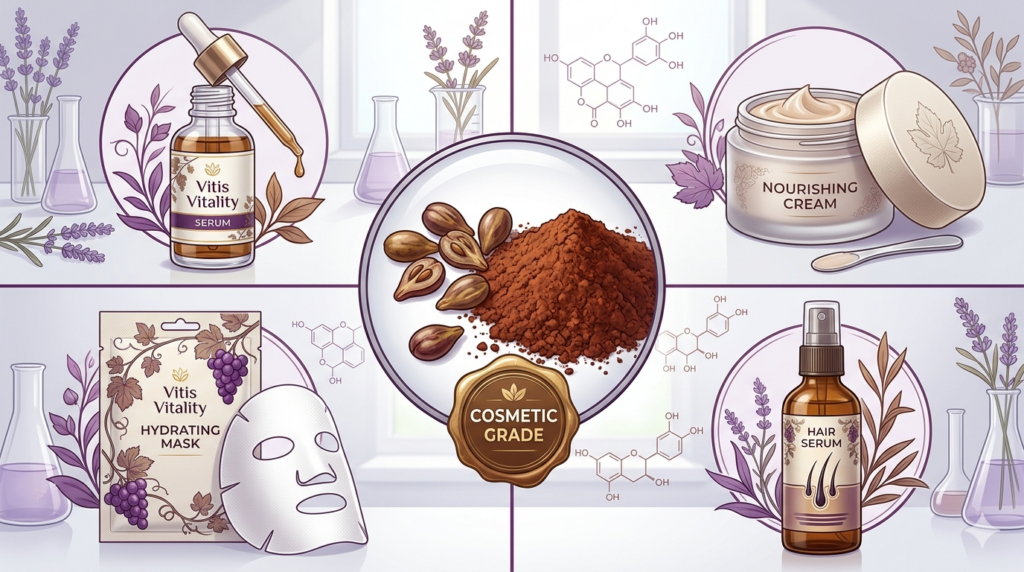
- Facial serums, creams, lotions, toners, and sheet masks
- Formulators value its light color, mild odor, and compatibility with both oil-in-water and water-based systems
Haircare & Scalp Products
- Shampoos, conditioners, scalp treatments, and leave-in serums
- Consistency in particle size and solubility is critical to avoid precipitation or sedimentation
Facial Masks & Leave-On Products
- Pullulan-based facial masks incorporating grape seed extract demonstrate strong antioxidant activity and selective antibacterial effects
Grape seed extract for cosmetics Recommended Usage Rates by Product Type
| Product Category | Recommended Dosage | Notes |
|---|---|---|
| Anti-aging serums | 0.5% – 2.0% | Water-phase addition |
| Day creams | 0.3% – 1.5% | Compatible with most emulsions |
| Facial masks | 1.0% – 3.0% | Wash-off or leave-on |
| Haircare products | 0.5% – 2.0% | Ensure solubility |
| Body lotions | 0.2% – 1.0% | Stable at pH 4.0–7.0 |
Quality Parameters for Cosmetic-Grade Grape Seed Extract
Sourcing Tips for Cosmetic Buyers
When sourcing grape seed extract for cosmetics, experienced procurement teams typically :
- Request cosmetic-grade specifications – not food-grade defaults
- Review batch-specific COA – not generic data sheets
- Test sample performance – in real formulations, not just on paper
- Confirm MOQ, lead time, and OEM flexibility – ensure supply chain reliability
References
- AIHerba. Grape Seed Extract Applications in Cosmetics: Formulation, Performance & Sourcing Guide. Standardized Botanical & Cosmetic Ingredients. 2025.
- Machała P, et al. Grape Seed Extract Encapsulation for Dermatological Care. Molecules. 2024;29(16):3717. DOI: 10.3390/molecules29163717
- Refai H, Elhabak M, Hassan DH, et al. Fabrication and in-depth analysis of a novel-hybrid TPGS phytosome system for enhanced anti photoaging efficacy of grape seed extract. ScienceDirect. 2025.
- Grape Seed Extract NSPCC1 Counteracts Mouse Skin Aging via Modulating MAPK and AMPK Pathways. Wiley. 2025.
- Encarnação B, et al. Production and Characterization of a Pullulan-Based Facial Mask Incorporating Grape Seed Flour Extract for Cosmeceutical Applications. European PMC. 2025.
Are you looking for certified origin, traceability or safety? We propose a full range of titrated herbal extract in accordance with GB, USP, EP, Pls find the list here. If not listed, please get contact with us at sales06@health-ingredients.com. Or you can search them by A-Z Product List.