

2026 Update | Multiple Plant Ingredients Now Classified | Immediate Effect
1. Background For EU Novel Food Catalogue 2026
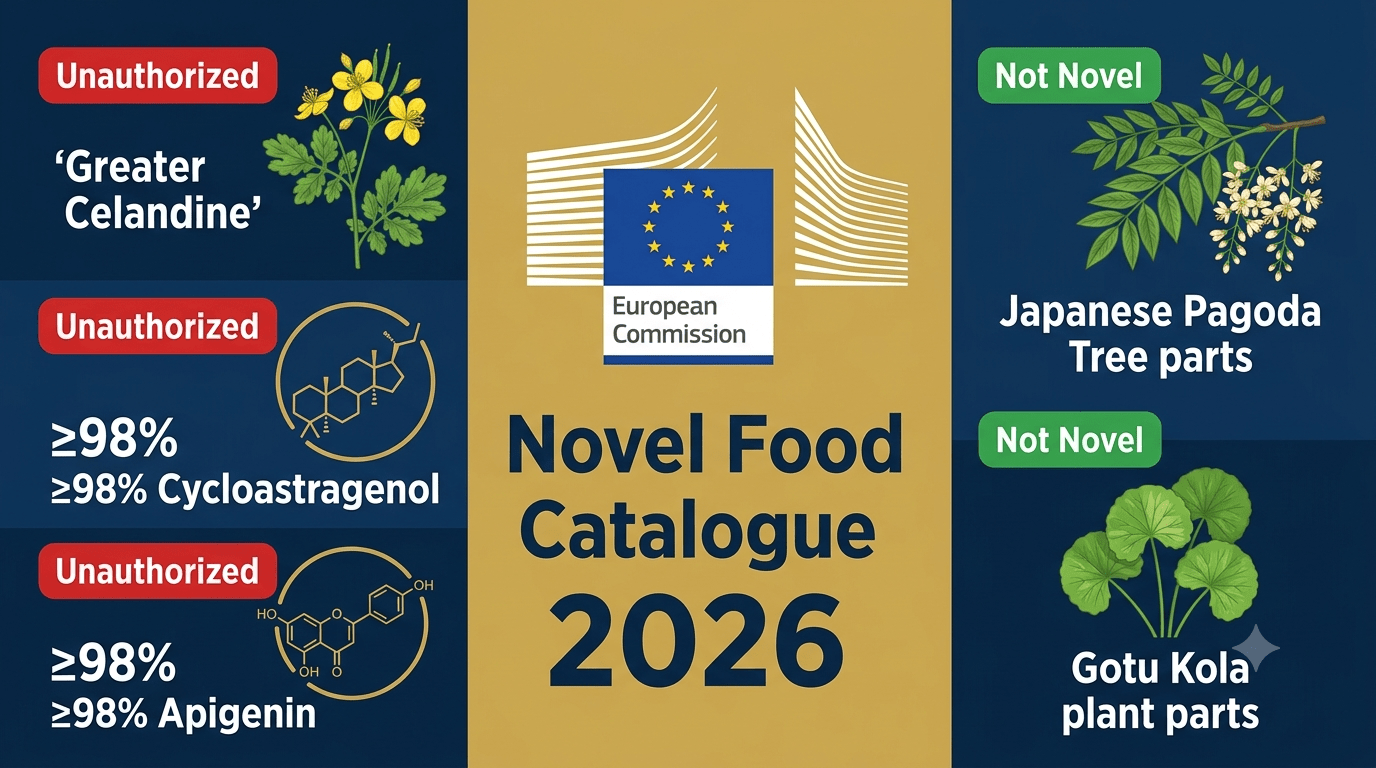
In early 2026, the European Commission updated the EU Novel Food Catalogue 2026, delivering long-awaited clarity on the regulatory status of several botanical ingredients. Following scientific assessments by EU Member State competent authorities, the legal positions of key ingredients—including Greater Celandine, Japanese Pagoda Tree, Cycloastragenol, Apigenin, Pterostilbene, Southern Ginseng, and Gotu Kola—have been formally confirmed with immediate effect.
Concurrently, the EC clarified the status of olive-derived ingredients, distinguishing traditional preparations from concentrated extracts, and approved multiple novel food substances including Lacto-N-tetraose (LNT) produced by a derivative strain of E. coli K-12 MG1655 through Commission Implementing Regulation (EU) 2026/397, effective 16 March 2026.
2. Botanical Ingredients: Regulatory Status List
Based on the European Commission’s EU Novel Food Catalogue 2026 Botanical Extracts list update, the following ingredients have received formal legal determinations:
| Ingredient | Botanical Source | Legal Status | Key Requirement |
|---|---|---|---|
| Greater Celandine | Chelidonium majus | Unauthorized Novel Food | Entire plant confirmed as novel food; not permitted in any food or supplement |
| Japanese Pagoda Tree | Styphnolobium japonicum | Not Novel (specific parts) | Young cooked leaves, flowers, flower buds, seed decoction, and stem decoction are authorized for use in food supplements |
| Cycloastragenol | Astragalus membranaceus | Unauthorized Novel Food | ≥98% purity specification classified as novel food; requires pre-market authorization |
| Apigenin | Matricaria chamomilla | Unauthorized Novel Food | ≥98% extract classified as novel food; requires pre-market authorization |
| Pterostilbene | Pterocarpus santalinus | Unauthorized Novel Food | ≥99% extract classified as novel food; requires pre-market authorization |
| Southern Ginseng | Gynostemma pentaphyllum | Unauthorized Novel Food | ≥80% gypenosides specification classified as novel food; requires pre-market authorization |
| Gotu Kola | Centella asiatica | Not Novel (plant parts) | Stems, flowers, and leaves remain not novel; ≥40% triterpenes extract is novel food requiring authorization |
3. Additional EU Novel Food catalogue 2026 Status Updates
The following ingredients also received regulatory status determinations in 2026:
4. Key Regulatory Principle: Purification Matters
The olive extract case illustrates a critical regulatory principle that applies broadly to botanical ingredients:
“While the raw material is a foodstuff, extracts with higher polyphenol concentrations are considered novel food due to a selective purification… These evaluations can be extrapolated to many botanical ingredients, for which the concentration in active compounds is increased compared to the raw material.”
— Jerome Le Bloch, Head of Scientific Affairs, FoodChain ID
How This Applies to Your Ingredients
| Scenario | Regulatory Status |
|---|---|
| Traditional plant parts (leaves, flowers, seeds) in natural form | Not Novel (based on pre-1997 consumption) |
| Aqueous infusions without concentration | Not Novel |
| Highly concentrated bioactive extracts | Novel Food (requires authorization) |
| Ingredients with ≥95–99% purity standards | Novel Food (requires authorization) |
5. What This Means for Your Business
Immediate Actions Required
Market Access Pathways
Data Protection Note
For newly authorized novel foods such as Lacto-N-tetraose produced by E. coli K-12 MG1655, the Commission has granted 5-year data protection to the original applicant (Inbiose N.V.) under Article 26 of Regulation (EU) 2015/2283. Subsequent applicants cannot rely on the protected scientific data without the original applicant’s agreement.
6. Outlook
The botanical novel food landscape, eu novel food catalogue 2026 will continue evolving. As Jerome Le Bloch noted, regulatory clarity often comes only after formal consultation requests submitted by food business operators—a lengthy but necessary process.
RD Health Ingredients’ Commitment
At RDHealthIngredients, we are:
- Monitoring all EU Novel Food Catalogue 2026 updates
- Ensuring our product portfolio complies with EU regulatory requirements
- Providing customers with up-to-date regulatory documentation
- Offering alternative compliant ingredients where needed
References
- CIRS Group. EU updates: S-adenosylmethionine disulfate tosylate classified as Novel Food. May 2026.
- European Commission. Commission Implementing Regulation (EU) 2026/397 of 23 February 2026 authorising lacto-N-tetraose produced by a derivative strain of Escherichia coli K-12 MG1655 as a novel food. Official Journal of the European Union.